
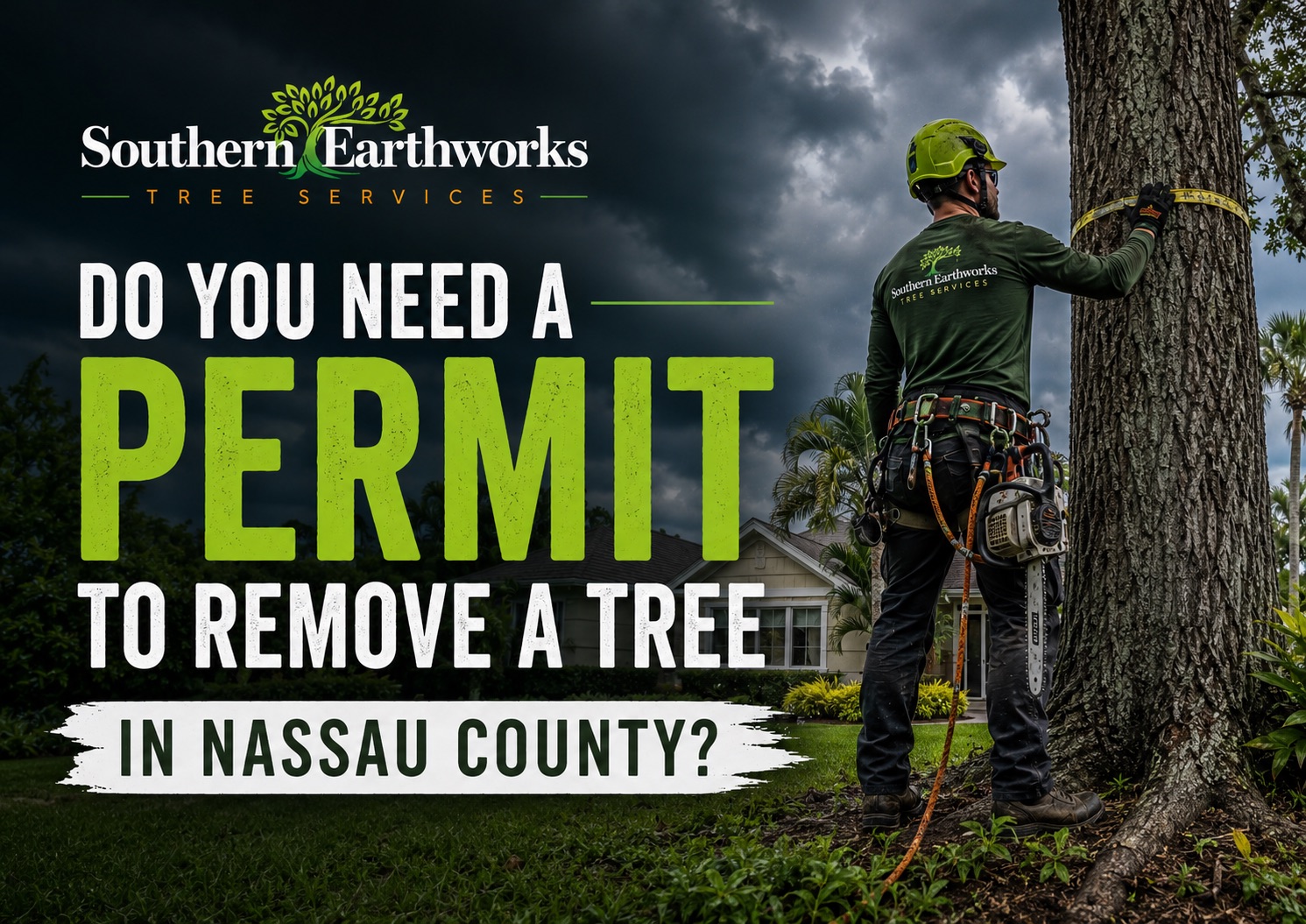
Removing a damaged, declining, or unwanted tree may seem straightforward, but local rules can vary depending on where the property is located, the size and condition of the tree, and whether the property is governed by an HOA.
In Nassau County, a permit is not required for every tree removal project. However, protected trees on Amelia Island, trees within Fernandina Beach, specimen trees, trees along designated canopy roads, mangroves, and trees connected to development projects may be subject to additional requirements.
Before scheduling tree removal, homeowners should confirm which rules apply to their specific property.
Is a Tree Removal Permit Always Required?
No. Nassau County does not appear to require one universal tree removal permit for every property throughout the county.
The answer can depend on:
- Whether the property is in unincorporated Nassau County
- Whether it is on Amelia Island
- Whether it is inside Fernandina Beach or another municipality
- The tree’s species, size, health, and location
- Whether the tree is near a designated canopy or scenic road
- Whether removal is connected to construction or development
- Whether the tree is a mangrove
- Whether an HOA has applicable restrictions
Property owners should confirm the jurisdiction before assuming that a tree can be removed without approval.
Tree Removal in Unincorporated Amelia Island
Nassau County requires a permit before removing a protected tree within the unincorporated portion of Amelia Island.
The County defines a protected tree as a healthy, non-invasive tree measuring at least five inches in diameter at breast height. The measurement is generally taken about 4.5 feet above the ground.
Additional rules apply to specimen trees and canopy-road trees. Nassau County defines a specimen tree as a healthy live oak measuring at least 40 inches in diameter, or a multi-trunk live oak with a combined diameter of at least 60 inches. A canopy-road tree is generally a qualifying healthy tree within the right-of-way of a designated canopy or scenic road.
Tree removal applications are reviewed by the County Arborist. The County states that permits are generally approved only when there is just cause, such as a hazardous tree or an approved development project. Removing a healthy protected tree solely for appearance may not qualify.
Routine pruning and minor maintenance generally do not require a permit, but the work must follow accepted tree-health standards.
Tree Removal Inside Fernandina Beach
Properties within Fernandina Beach are governed by the City’s tree regulations rather than the rules for unincorporated Amelia Island.
Fernandina Beach requires a permit to remove a protected tree unless an exemption applies. The City’s current permitting page describes protected trees as healthy, non-invasive trees measuring five inches or more in diameter at breast height.
Permit and mitigation requirements may apply when protected trees are removed for construction or site development. Mitigation may include preserving other trees, planting replacements, or paying a fee instead.
The City also lists significant fines for unauthorized tree removal. Property owners in Fernandina Beach should verify the tree’s status before work begins.
What About Dead, Diseased, or Hazardous Trees?
An exemption may apply when a tree presents an unacceptable risk to people or property.
Florida law states that a local government may not require a permit, application, fee, approval, or mitigation for removing a tree from qualifying residential property when the owner possesses proper documentation from an ISA Certified Arborist or Florida-licensed landscape architect. The assessment must determine that the tree poses an unacceptable risk and that removal is the only practical way to reduce that risk below a moderate level.
This law applies specifically to an actively used, detached single-family residential property that qualifies under local land-development regulations. It should not automatically be assumed to cover vacant lots, commercial properties, multifamily properties, or every development situation.
Nassau County asks property owners to submit a copy of the tree-risk assessment for its records. The County also notes that its local exemption does not include specimen trees or qualifying trees along designated canopy or scenic roads.
Fernandina Beach similarly states that trees assessed as hazardous, dead, dying, or diseased by an ISA Certified Arborist or licensed landscape architect do not require a removal permit.
Homeowners should obtain a professional assessment before the tree is removed. A personal belief that a tree looks unsafe may not be enough to qualify for the exemption.
Does an HOA Need to Approve Tree Removal?
Possibly.
A government permit does not replace private HOA approval. An HOA may have recorded covenants or architectural guidelines governing tree removal, landscaping changes, natural buffers, conservation areas, or exterior property improvements.
Florida law permits an HOA or architectural committee to review certain exterior improvements when that authority is stated or reasonably supported by the community’s declaration and authorized published guidelines.
Before removing a tree, homeowners should review:
- The declaration of covenants
- Architectural review guidelines
- Landscaping requirements
- Recorded plats and easements
- Conservation-area or buffer restrictions
- Rules regarding contractor access and debris removal
When approval is required, obtain it in writing. HOA approval does not replace a city or county permit, and a city or county permit does not automatically override private community restrictions.
What About Mangroves?
Mangroves are governed by separate Florida environmental regulations. Tree-removal rules and hazardous-tree exemptions should not be treated as permission to remove or heavily trim mangroves.
Florida protects red, black, and white mangroves, including rooted seedlings. Some limited trimming may qualify for an exemption or general permit, but removal or substantial alteration may require authorization from the Florida Department of Environmental Protection.
Property owners should contact the Department before trimming or removing shoreline mangroves.
Trees Near Roads, Parks, and Power Lines
Do not remove a tree that may be within a public right-of-way without confirming ownership and receiving permission.
Nassau County directs residents to contact the County Road Department or County Arborist about trees along county roads or in county parks. Trees affecting state roads should be reported to the Florida Department of Transportation. Trees conflicting with power lines should be reported to the appropriate utility provider.
Attempting to remove a tree near energized lines can be extremely dangerous and should be left to qualified utility or tree-care professionals.
Check Before You Remove a Tree
Before scheduling removal, determine:
- Whether the property is inside Fernandina Beach or unincorporated Nassau County
- Whether the property is on Amelia Island
- Whether the tree meets the local definition of a protected or specimen tree
- Whether the tree is near a canopy road, right-of-way, wetland, or conservation area
- Whether an arborist assessment is needed
- Whether an HOA requires written approval
- Whether the tree is a protected mangrove
- Whether removal is part of a construction or development project
Contact Southern Earthworks Tree Services
Need professional tree removal, trimming, stump grinding, or storm cleanup in Nassau County or Northeast Florida? Southern Earthworks Tree Services can evaluate your property, explain the work involved, and help you determine which questions should be addressed before removal begins.
Call 904 583 9908 or visit our Contact Us page to request an estimate.
This article provides general information and is not legal or permitting advice. Regulations and property restrictions may change. Confirm current requirements with Nassau County, the applicable municipality, environmental agencies, utility providers, and your HOA before removing a tree.



Leave A Comment