
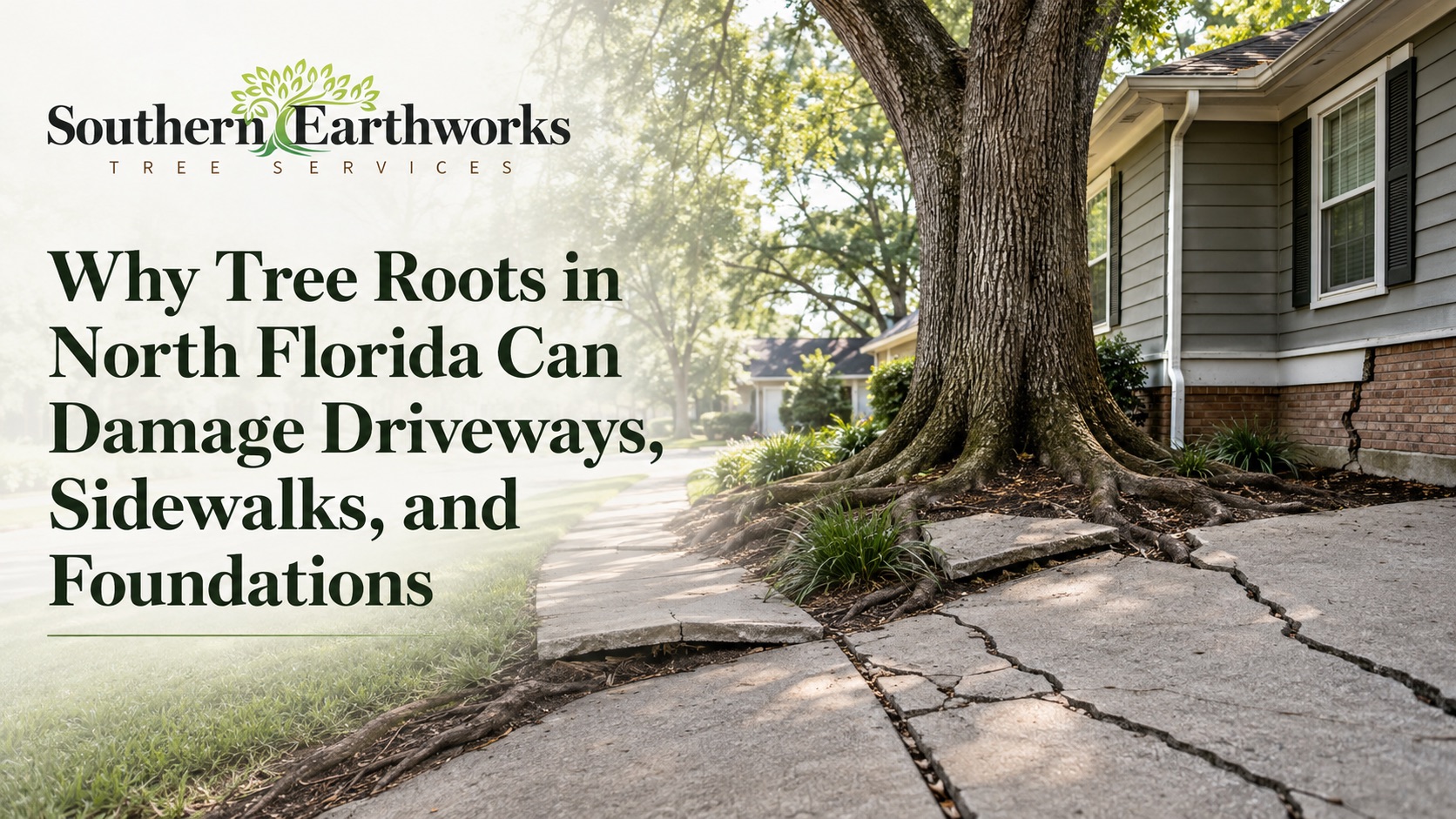
A tree may look perfectly healthy above ground while its roots are slowly expanding beneath the soil. Over time, those roots can contribute to lifted pavement, uneven concrete, damaged landscaping, drainage problems, and concerns around structures.
At Southern Earthworks Tree Services, we help homeowners, builders, property managers, and businesses throughout Northeast Florida identify tree-related property risks and determine the best next step. Our services include tree removal, stump grinding, stump excavation, tree inspections, arborist consultations, emergency tree service, and commercial tree work.
For homeowners who want to better understand how tree roots interact with pavement and other hardscapes, the University of Florida IFAS provides helpful guidance on trees, sidewalks, driveways, patios, and other residential hardscapes.
Why Tree Roots Grow Toward Hardscapes
Tree roots need water, oxygen, nutrients, and enough soil space to support the tree.
In a natural setting, roots can spread through a broad area of open soil. Residential and commercial properties are different. Buildings, driveways, sidewalks, patios, retaining walls, compacted soil, drainage systems, and underground utilities can all limit where roots are able to grow.
Most tree roots remain relatively close to the soil surface, particularly where the soil is compacted or poorly drained. When shallow roots encounter pavement or concrete, they may continue expanding underneath it or along the edge of the hard surface.
That is when homeowners often begin noticing cracked or raised areas.
Why Tree Roots Can Lift Sidewalks
Roots growing underneath a sidewalk can increase in diameter over time.
As a root expands, it can push against the soil and concrete above it. Eventually, one section of the sidewalk may begin lifting higher than another.
The most obvious warning sign is a section of concrete that rises near the base of a tree.
This can create an uneven walking surface and a potential trip hazard. On commercial properties, HOA communities, schools, and other high-traffic locations, an uneven sidewalk can become more than an appearance problem.
The closer a large tree is planted to the sidewalk, the greater the likelihood that its root system may eventually interact with the pavement.
Driveways Can Be Affected Too
Driveways create another large hard surface that can come into conflict with growing tree roots.
Roots may grow beneath concrete, asphalt, pavers, or along driveway edges where soil and moisture are available.
Homeowners may begin noticing raised sections of concrete, separated pavers, cracking along one side of the driveway, or areas that no longer drain the way they once did.
As the surface moves, water can begin collecting in low areas or flowing in a different direction. That can make an existing driveway problem worse over time.
Many homeowners inherit mature trees that were planted years before anyone realized how large they would eventually become.
By the time the driveway begins showing damage, simply relocating the tree is no longer an option.
Tree Roots Near a Foundation Deserve Attention
Homeowners are understandably concerned when they see a large tree growing close to their home.
Tree roots do not typically behave like drills that simply penetrate an intact concrete foundation. However, trees planted too close to buildings can still create legitimate concerns.
Roots can interact with existing cracks, walls, patios, walkways, plumbing, drainage systems, and surrounding soil.
For North Florida homeowners, the bigger concern is often the entire relationship between the tree and the structure.
A large tree very close to a home may have roots extending beneath nearby hardscapes while its canopy and trunk create additional risk during hurricanes and thunderstorms.
That is why the situation should be evaluated as a whole rather than assuming that cutting a visible root will solve the problem.
Cutting Large Roots Can Make a Tree Dangerous
When a root lifts a sidewalk or driveway, the obvious solution may seem to be cutting the root.
That can create a much bigger problem.
Large structural roots help anchor a tree into the ground. Removing major roots too close to the trunk can weaken that support system and increase the chance that the tree will become unstable.
This is especially important in North Florida, where trees may eventually have to withstand tropical storms, hurricanes, saturated soil, and high winds.
A sidewalk repair is not worth creating a hazardous tree beside your home.
Before cutting significant roots, it is better to have the tree and surrounding property evaluated professionally.
Florida’s Soil Conditions Can Make the Problem More Complicated
North Florida properties vary considerably.
Some areas have sandy soil. Others have compacted fill, clay, high water tables, drainage limitations, or soil that has been heavily disturbed during development.
These conditions influence how a tree develops its root system.
When roots cannot grow deeply, they often spread through shallower soil layers.
That combination can create two problems at once.
Shallow roots may interfere with driveways and sidewalks while also giving the tree less deep anchorage during severe weather.
That is why visible root problems around pavement can sometimes be a sign that the entire tree should be evaluated.
How Close Is Too Close?
There is no single distance that works for every tree and every property.
Species, mature size, soil conditions, drainage, available rooting space, and nearby structures all matter.
However, the general rule is simple: large trees need room.
A small tree planted beside a driveway may not create problems for years. But if that tree eventually reaches 50 or 60 feet tall, the root system required to support it will be much larger than it was when the tree was first installed.
Good tree placement can prevent many of these problems before they begin.
Signs That Tree Roots May Be Affecting Your Property
The problem often develops gradually.
You may notice that one sidewalk slab sits higher than the next. Pavers may begin separating. A driveway may develop cracking near a mature tree. Roots may become visible above the soil. A retaining wall might begin moving, or water may start collecting where it did not collect previously.
Sometimes the tree itself also shows signs that deserve attention.
A strong lean, exposed roots, soil lifting around the base, previous root cutting, storm damage, or significant construction around the root zone can all affect tree stability.
At Southern Earthworks Tree Services, we provide tree inspections and arborist consultations to help property owners better understand what they are dealing with before making a decision.
Sometimes the Tree Can Stay
Finding roots near pavement does not automatically mean a tree needs to be removed.
Depending on the tree, location, amount of damage, and root structure, there may be ways to preserve the tree while repairing the surrounding hardscape.
In other situations, the tree may simply be too large for the space where it was planted.
A mature tree squeezed between a foundation, driveway, sidewalk, fence, and road may have very few options for healthy root growth.
When the tree is creating repeated damage or becoming a safety concern, removal may eventually be the most practical solution.
Tree Removal May Only Be Part of the Job
When a tree is removed because of root-related property damage, the remaining stump and root system still need to be considered.
At Southern Earthworks Tree Services, we offer both stump grinding and stump excavation.
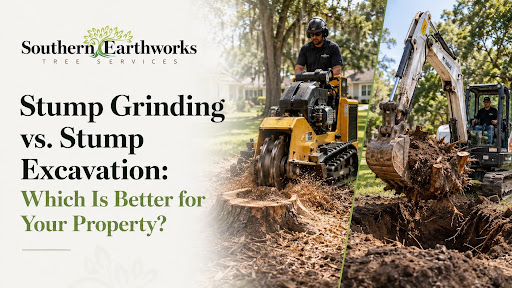
Stump grinding reduces the visible stump below grade and may be appropriate when the area will remain landscaped.
Stump excavation is a more complete approach that can be useful when the property needs to be prepared for a driveway repair, building project, new hardscape, site work, or another use where the remaining stump and root mass would interfere.
For builders and commercial properties, we also provide site clearing, stump excavation, large tree removal, and tree services around active job sites.
The right approach depends on what needs to happen with the property after the tree is gone.
North Florida Storms Make Tree Stability Even More Important
Root problems should never be viewed only as a landscaping issue.
The root system is what keeps a tree standing.
A tree that has experienced significant root damage, construction disturbance, aggressive root cutting, erosion, or poor anchorage may become more vulnerable during severe weather.
That matters in Northeast Florida.
Our region experiences thunderstorms, tropical systems, hurricanes, saturated soil, and high winds. Southern Earthworks provides emergency tree service, hurricane cleanup, hazardous tree removal, and storm response when trees become dangerous or fail.
Addressing a questionable tree before hurricane season is usually better than discovering the problem after the tree has fallen across a driveway, roof, fence, or vehicle.
Choosing the Right Tree Service Matters
Tree and root problems can require heavy equipment, careful planning, and an understanding of how removing one part of the root system may affect the rest of the tree.
At Southern Earthworks Tree Services, we treat every property with the same care we would want for our own.
We are fully licensed and insured, have completed more than 1,000 projects since 2021, hold Master Logger certification, and have access to certified arborists for specialized needs. We work with homeowners, builders, developers, HOAs, municipalities, schools, commercial property managers, and businesses throughout Northeast Florida.
Our goal is not simply to remove a tree. It is to help you determine the safest and most practical solution for the property.
Protect Your Property Before Root Damage Gets Worse
A cracked driveway or lifted sidewalk may start as a small inconvenience, but tree root problems can become more complicated as the tree continues growing.
If you have roots lifting a sidewalk, damaging a driveway, growing close to a foundation, or interfering with an upcoming construction project, it is worth having the situation evaluated before making major repairs or cutting roots yourself.
At Southern Earthworks Tree Services, we can evaluate your trees and help determine whether trimming, monitoring, tree removal, stump grinding, or stump excavation makes the most sense.
Call us at 904.583.9908 or request a free estimate through our contact page.


Leave A Comment