
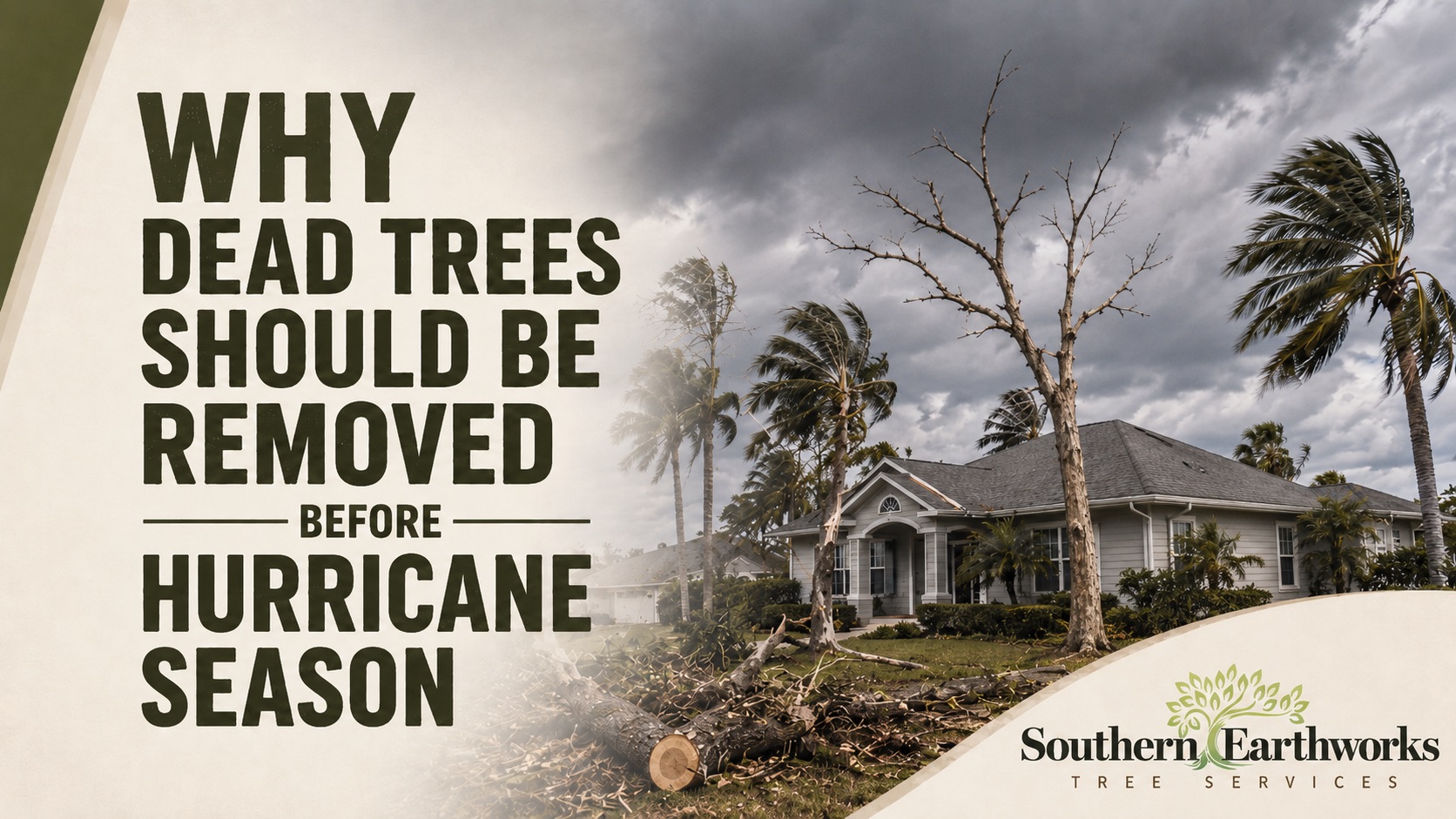
Hurricane season brings high winds, heavy rain, flooding, and saturated soil to Northeast Florida. While many property owners prepare their homes, vehicles, generators, and outdoor furniture, the trees surrounding the property are sometimes overlooked.
A healthy, well-maintained tree may be able to handle severe weather better than a tree that is already dead, decaying, damaged, or structurally unstable. Dead trees do not become safer by waiting. As branches weaken and roots deteriorate, the likelihood of failure can increase, especially when strong winds and waterlogged soil arrive.
Southern Earthworks Tree Services helps homeowners, builders, property managers, and businesses prepare their properties through professional tree inspections, trimming, removal, stump services, emergency response, and hurricane cleanup. The company is fully licensed and insured, provides access to arborist expertise, and serves customers throughout Northeast Florida.
Dead Trees Are More Vulnerable to Strong Winds
A dead tree no longer has the same flexibility, moisture balance, or living structure as a healthy tree. Its branches can become dry and brittle, while decay may weaken the trunk and root system.
During ordinary weather, a dead tree may remain standing and appear stable. Hurricane-force winds can expose weaknesses that are not obvious from the ground. Limbs may break, trunks may split, and the entire tree may fall.
UF/IFAS advises property owners to look for dead or broken branches, trunk wounds, unusual bulges, bark loss, soil movement around the roots, and mushrooms near the base of a tree. These signs may point to structural weakness, disease, decay, or root problems that deserve professional attention before hurricane season begins.
Heavy Rain Can Make an Unstable Tree Even More Dangerous
Hurricanes do not bring wind alone. Prolonged rainfall can saturate the soil and reduce the support surrounding a tree’s roots.
If a dead or declining tree already has damaged roots, internal decay, or poor anchoring, saturated ground can make it more likely to uproot. A tree that has stood through previous storms is not guaranteed to survive the next one because its condition may have changed over time.
Tree failure generally involves the branches, trunk, or root system. Periodic inspection of all three areas can reveal potential problems before they become emergencies.
Falling Trees Can Cause Serious Property Damage
A dead tree near a home, garage, driveway, commercial building, fence, parked vehicle, utility line, or public access area can create a serious hazard.
If the tree or one of its limbs falls, the damage may involve roofing, siding, windows, vehicles, landscaping, outdoor equipment, or nearby structures. Falling limbs may also block driveways and roads when quick access is most important.
Southern Earthworks Tree Services warns that overgrown limbs, dead trees, and storm damage can put homes and families at risk. Its services include tree removal, tree trimming and pruning, emergency tree service, hurricane cleanup, tree inspections, and arborist consultations.
Waiting Until a Storm Is Approaching Can Limit Your Options
Tree removal should not be treated as a last-minute hurricane preparation task.
As a storm approaches, reputable tree companies may receive a large number of emergency calls. Weather conditions can also make tree work more difficult or unsafe. Removing a hazardous tree while the weather is calm gives the crew more control over equipment placement, access, debris removal, and protection of nearby property.
UF/IFAS recommends contacting a certified arborist for an evaluation well in advance of hurricane season rather than waiting until severe weather is close.
Scheduling early also gives the property owner time to decide whether the tree should be removed, pruned, monitored, or evaluated further.
Not Every Unhealthy Tree Needs Immediate Removal
A tree that looks unhealthy is not automatically beyond saving. Some trees can be managed through corrective pruning, treatment, or ongoing monitoring.
However, a tree that is completely dead cannot recover. When a dead tree is located near people, buildings, roads, vehicles, or other valuable property, removal is often the safest long-term solution.
UF/IFAS explains that tree-care professionals can help determine whether a storm-damaged or declining tree may be restored or should be removed. The decision depends on the tree’s condition, species, structure, remaining canopy, roots, and potential targets beneath it.
A professional evaluation is especially important when the tree is large, close to a structure, leaning, split, hollow, or showing signs of root decay.
Dead Branches Can Be Dangerous Even When the Tree Is Still Standing
The entire tree does not have to fall to cause damage.
Large dead limbs can separate from the canopy during strong wind and travel toward roofs, vehicles, windows, walkways, power lines, or neighboring property. Smaller branches can also become dangerous flying debris during a hurricane.
Proper tree trimming and pruning can remove dead, broken, or weak limbs from trees that remain healthy enough to preserve. Southern Earthworks Tree Services provides professional trimming and hazard-reduction services for residential properties, commercial sites, HOAs, builders, municipalities, schools, golf courses, resorts, and industrial locations.
This work should be completed by experienced professionals who understand tree structure and avoid harmful practices that may weaken the remaining canopy.
Improper Pruning Can Make Storm Damage Worse
Hurricane preparation does not mean removing as many branches as possible.
Aggressive topping, lion-tailing, over-lifting, and excessive canopy removal can damage a tree and create weak regrowth. Palms also should not receive unnecessary “hurricane cuts,” which can remove healthy fronds and weaken the tree.
UF/IFAS advises against topping trees and excessive pruning. Proper structural pruning focuses on dead, damaged, poorly attached, or hazardous branches while preserving the tree’s natural strength.
Southern Earthworks Tree Services specifically emphasizes proper palm trimming techniques and avoiding damaging hurricane cuts.
Dead Trees Can Affect More Than One Property
A hazardous tree may threaten neighboring homes, fences, vehicles, roads, sidewalks, or shared spaces.
This is especially important for commercial properties, apartment communities, HOAs, schools, parks, golf courses, and job sites where more people may pass beneath or near the tree each day.
Property managers and business owners need a tree service provider that understands safety procedures, scheduling, access requirements, ongoing operations, and cleanup. Southern Earthworks Tree Services works with builders, developers, commercial property managers, HOAs, municipalities, schools, universities, parks, resorts, and industrial sites throughout Northeast Florida.
Professional Removal Is Safer Than DIY Tree Work
Dead trees can be unpredictable. Branches may break without warning, trunks may be hollow, and roots may no longer provide reliable support.
Attempting to remove a large dead tree without professional equipment and experience can result in injury, property damage, or uncontrolled tree movement. The risk becomes even greater when the tree is near a building, fence, driveway, road, utility line, or another tree.
Southern Earthworks Tree Services uses experienced crews and professional equipment for tree removal, trimming, stump grinding, stump excavation, storm cleanup, and emergency response. The company states that it is fully licensed and insured, Master Logger certified, and supported by access to certified arborists.
Tree Removal Should Include a Plan for the Stump and Debris
Removing the trunk and canopy is only part of the project.
The remaining stump may interfere with mowing, landscaping, construction, drainage, or future planting. It may also create a trip hazard or allow unwanted sprouts to develop around the root area.
Southern Earthworks Tree Services offers both stump grinding and stump excavation, allowing the final approach to match the future use of the property. The company also emphasizes leaving properties clean and safer after the work is complete.
An Inspection Can Help Identify Problems Before the Storm
Some hazardous trees are clearly dead. Other trees may have hidden structural problems that are difficult to recognize without experience.
A professional inspection may evaluate the canopy, branch attachments, trunk, bark, cavities, lean, root flare, soil changes, fungal growth, storm damage, and the locations of nearby structures or people.
UF/IFAS recommends periodic tree inspections because early identification of defects can significantly reduce risk, even though no tree can ever be considered completely risk-free.
Property owners can also review the University of Florida’s guidance on preparing trees and landscapes for hurricane season and assessing hurricane-damaged trees.
Prepare Before Hurricane Season Arrives
Removing a dead tree before hurricane season can help reduce the chance of falling limbs, uprooted trunks, blocked access, property damage, and emergency cleanup.
The safest time to address a hazardous tree is before strong winds and saturated soil put additional pressure on it. Early service also gives property owners more time to schedule an inspection, receive a clear estimate, plan the work, and complete cleanup under safer conditions.
Southern Earthworks Tree Services provides professional tree trimming, tree removal, stump grinding, stump excavation, emergency tree service, hurricane cleanup, tree inspections, and arborist consultations throughout Northeast Florida.
Call Southern Earthworks Tree Services at 904-583-9908 or request a free estimate through the contact page.



Leave A Comment